
How to Use WhatsApp API for Restaurants to Automate Orders & Double Revenue (2025)
The Profit-Crushing Problem with Third-Party Delivery Apps
If you are tired of losing up to 30% of your hard-earned margins to third-party delivery applications, implementing a WhatsApp API for restaurants is the most profitable pivot you can make this year. The modern food service industry is hyper-competitive, and while platforms like UberEats and DoorDash provide visibility, they aggressively eat into your bottom line.
To survive and scale in 2025, restaurants must own their customer data and control the ordering experience. Customers already spend hours every day on WhatsApp. By bringing your menu, ordering system, and customer support directly to the app they already use, you reduce friction and dramatically increase conversion rates.
In this comprehensive guide, we will explore exactly how the WhatsApp API for restaurants works, the most profitable use cases, and how developers can integrate it seamlessly with existing Point of Sale (POS) systems.
What is the WhatsApp API for Restaurants?
Unlike the standard WhatsApp Business app—which is meant for manual replies on a single device—the WhatsApp API allows businesses to programmatically send and receive messages at scale. It acts as a bridge between your restaurant’s software (like your POS, CRM, or booking system) and your customers' WhatsApp accounts.
By leveraging this technology, restaurants can deploy intelligent chatbots, send automated order updates, process payments, and broadcast promotional messages to thousands of past customers simultaneously.
The beauty of this integration is that the customer doesn't need to download a new app or learn a new interface. They simply send a message to your restaurant's phone number, and the automation takes over.
5 Profitable Use Cases for WhatsApp Automation in Food Service
1. Zero-Commission Direct Food Ordering
The most lucrative application of the WhatsApp API for restaurants is building a direct ordering channel. Instead of routing loyal customers through expensive third-party apps, you can train them to order directly via WhatsApp.
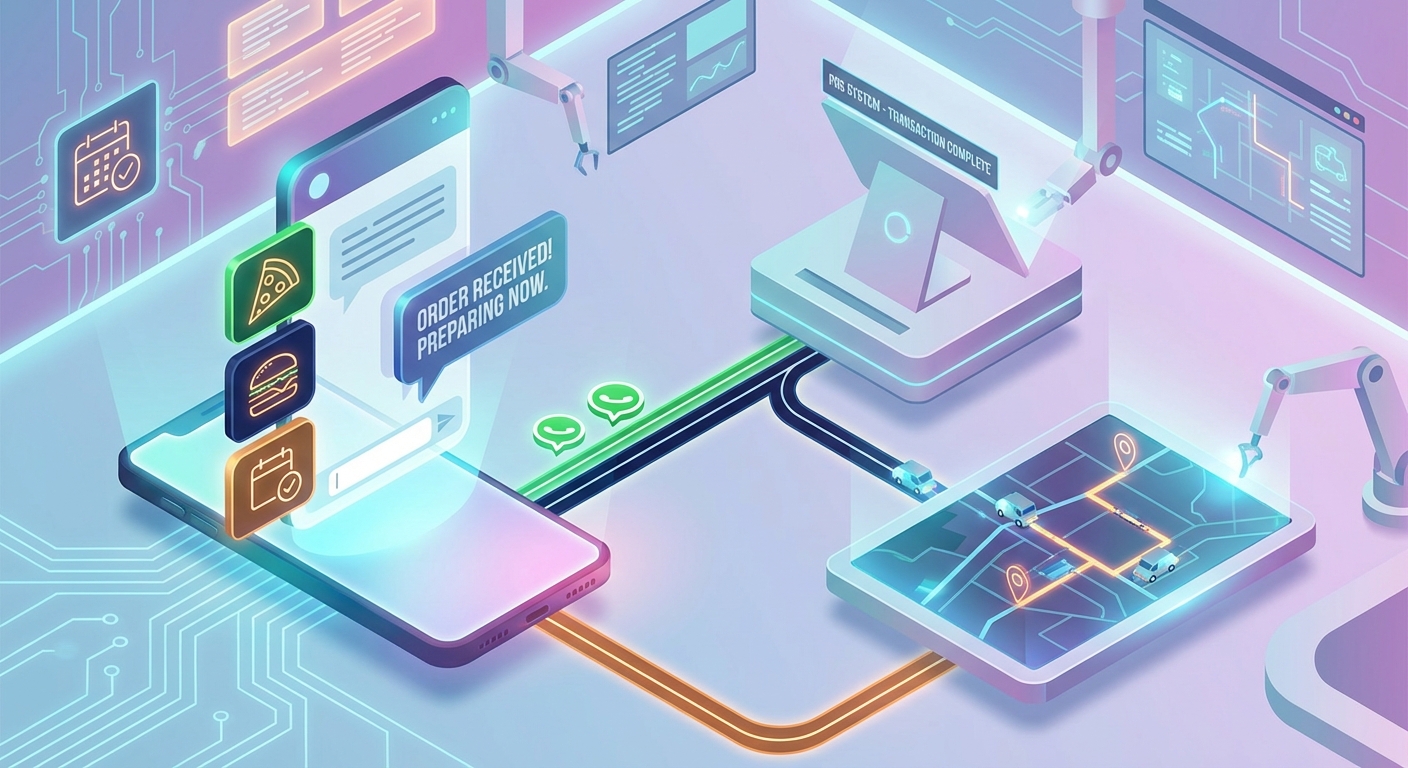
Here is how a typical automated ordering flow works:
- Initiation: The customer sends a message saying "Menu" or "Order."
- Interactive Menu: The API instantly replies with an interactive list message categorizing your food (e.g., Starters, Mains, Desserts, Drinks).
- Selection: The customer taps their choices. The bot calculates the total price, including taxes and delivery fees.
- Checkout: The bot provides a payment link or confirms cash-on-delivery.
- POS Sync: The order is automatically pushed to your kitchen display system via webhooks.
Because you own the channel, you keep 100% of the revenue. Even if you offer a 10% discount for ordering via WhatsApp, you are still saving massive amounts on commission fees.
2. Automated Table Reservations & Reminders
Managing reservations manually leads to missed calls during rush hours, double-bookings, and human error. A WhatsApp-powered reservation system operates 24/7 without needing a host on the phone.
Customers can text your business to check table availability. The bot queries your booking database in real-time and offers available time slots using interactive buttons. Once the customer selects a time, the bot confirms the reservation and updates your internal calendar.
Pro Tip: You can drastically reduce no-shows by configuring the API to send an automated reminder two hours before the reservation, complete with a button to confirm or cancel.
3. Real-Time Delivery Tracking & Order Updates
One of the biggest drains on restaurant staff is answering the phone just to tell a customer, "Your food is on the way." Proactive communication solves this.
By integrating your delivery management software with the WhatsApp API, you can trigger automated alerts at key stages of the fulfillment process:
- "Your order has been received and is being prepared by our chefs! 👨🍳"
- "Your food is out for delivery! Track your driver here: [Link] 🛵"
- "Your order has arrived. Enjoy your meal! 🍔"
This level of transparency builds immense trust and keeps your phone lines clear for actual revenue-generating activities.
4. Instant Customer Support & FAQ Handling
Customers often have the same repetitive questions: What are your opening hours? Do you have vegan options? Is your meat halal? Are you open on holidays?
Instead of tying up your staff, you can program your WhatsApp bot to instantly answer these FAQs. If a customer has a complex issue—such as a missing item in their delivery—the API can seamlessly route the conversation to a human manager's dashboard, ensuring high-quality customer service.
5. Hyper-Targeted Loyalty Programs and Broadcasts
Email marketing in the restaurant industry typically yields a 15-20% open rate. WhatsApp messages boast an astonishing 98% open rate. This makes it the ultimate tool for customer retention.
With the API, you can tag customers based on their order history and send highly targeted broadcast messages. For example:
- Send a "Free Dessert" coupon on a customer's birthday.
- Broadcast a "Slow Tuesday Special" to customers who haven't ordered in 30 days.
- Alert your VIP customers about a new seasonal menu before anyone else.
Technical Architecture: How to Build a WhatsApp Ordering System
If you are a developer tasked with building a WhatsApp solution for a restaurant, the architecture is remarkably straightforward once you understand the core components.
Step 1: Choose the Right WhatsApp API Provider
You have two main paths: the Official Meta Cloud API or an Unofficial API like WaSenderAPI. For restaurants, unofficial APIs are often vastly superior. Meta charges per conversation, meaning if you send a promotional blast to 5,000 customers, it could cost you hundreds of dollars. Unofficial APIs offer flat-rate, unlimited messaging, which is crucial for high-volume, low-margin businesses like restaurants.
Step 2: Set Up Webhooks for Real-Time Data
To make the system dynamic, you need to configure webhooks. Whenever a customer sends a message, the API fires a POST request to your server. Your server processes the intent (e.g., "wants to see menu"), queries your database, and sends the appropriate JSON payload back to the API.
For detailed endpoint configurations, message formatting, and webhook setup, check out the official API documentation.
Step 3: Leverage Interactive UI Elements
Do not force users to type out their orders; typos will break your bot's logic. Instead, utilize WhatsApp's native interactive elements. Use List Messages for menus with up to 10 options, and Reply Buttons for quick binary choices like "Dine-In" or "Takeaway".
Step 4: Integrate with the POS System
The holy grail of restaurant automation is seamless POS integration. Whether the restaurant uses Square, Toast, or Revel, you will need to map your WhatsApp bot's output to the POS system's order creation endpoints. This ensures that a WhatsApp order prints in the kitchen exactly like a ticket from the front counter.
Best Practices for Restaurant WhatsApp Marketing
While the technology is powerful, the strategy behind it dictates your success. Keep these best practices in mind to maximize engagement and avoid annoying your customers.
1. Always Get Opt-In Consent: Never buy phone number lists. Only message customers who have explicitly agreed to receive updates from you. You can gather opt-ins by placing QR codes on your physical tables or offering a discount on their first WhatsApp order.
2. Use High-Quality Media: Food is highly visual. Don't just send plain text menus. Send mouth-watering images of your signature dishes or short video clips of food preparation. A great photo can trigger an impulse purchase instantly.
3. Time Your Broadcasts Perfectly: Timing is everything in food service. Do not send a lunch special at 8:00 AM. Send it at 11:15 AM, right when office workers are starting to feel hungry and wondering what to eat.
4. Keep the Flow Simple: The fewer steps it takes to order, the higher the conversion rate. Aim for a 3-step checkout process: Select Item -> Confirm Details -> Pay.
Conclusion: The Future of Dining is Conversational
The restaurant industry is shifting rapidly toward direct-to-consumer models. Relying entirely on delivery aggregators is a recipe for shrinking margins and lost customer relationships. By deploying a robust WhatsApp API for restaurants, you empower your business with a direct, zero-commission sales channel that lives right in your customers' pockets.
Whether you want to automate table reservations, streamline delivery tracking, or build a highly profitable digital menu, the tools are now accessible and affordable. Start building your WhatsApp ordering system today, and watch your customer loyalty—and profit margins—soar in 2025.
Related Posts
n8n + WaSenderAPI: Master WhatsApp Automation Without Code (2025 Guide)
Discover the most affordable WhatsApp automation solution only $6/month with WaSenderAPI combined with no-code n8n workflows. Build perfect, custom WhatsApp automations quickly and easily without coding. Follow our step-by-step guide to save costs while creating powerful, scalable, and secure WhatsApp messaging for your business.

Create a Free WhatsApp AI Chat Bot with Python and Gemini (Full Guide)
Learn how to create a free WhatsApp AI chatbot using Python, Google’s Gemini API, and WaSenderAPI. This step-by-step guide helps you build and deploy an intelligent WhatsApp assistant at minimal cost no need for WhatsApp Business API.

WhatsApp API Rate Limits Explained: How to Scale Messaging Safely in 2025
Struggling with WhatsApp messaging restrictions? Learn how Meta's tier system works, how to upgrade your daily limits, and how to scale your broadcasts safely without getting banned.