Evolution API Hosting: How to Host Evolution API and Choose the Right WhatsApp API Solution
Evolution API has become a popular choice for developers who want to integrate WhatsApp messaging into their own applications. Because it is self-hosted, developers can deploy it on a VPS or cloud server and build their own WhatsApp automation, chatbots, CRM integrations, and messaging platforms.
But hosting Evolution API yourself also means managing servers, databases, containers, WhatsApp sessions, updates, security, backups, and uptime. For developers who want to focus on their application rather than infrastructure, a managed WhatsApp API can be a simpler alternative.
Looking for a simpler alternative? WasenderAPI provides a developer-focused WhatsApp API with managed infrastructure, multiple WhatsApp sessions, webhooks, unlimited messaging, and no per-message fees.
What Is Evolution API?
Evolution API is an open-source WhatsApp API project designed to provide developers with an API layer for interacting with WhatsApp. It can be deployed on your own infrastructure and integrated with applications such as CRMs, customer-support systems, automation platforms, and AI assistants.
Instead of building a WhatsApp integration from scratch, developers can use an API to perform common messaging operations and receive events through webhooks.
Typical use cases include:
- WhatsApp chatbots
- Customer support systems
- CRM integrations
- Lead management platforms
- Order and delivery notifications
- AI-powered WhatsApp assistants
- Marketing and customer engagement workflows
- Internal business automation
Why Do Developers Host Evolution API?
One of the main advantages of self-hosting is control. Instead of relying entirely on a third-party infrastructure provider, you can deploy the application on infrastructure that you manage.
1. Full Server Control
With self-hosting, you decide where the application runs and how the surrounding infrastructure is configured. You can choose your VPS provider, operating system, database configuration, networking setup, backups, and monitoring tools.
2. Custom Infrastructure
Developers building larger systems may want to integrate their WhatsApp API deployment with their existing Docker, Kubernetes, CI/CD, monitoring, and cloud infrastructure.
3. Developer Flexibility
Self-hosted software can be useful when you need more control over deployment and application architecture. You can build additional services around the API and connect it with your existing backend.
How to Host Evolution API
The exact deployment process depends on the Evolution API version and deployment method you choose, but a typical self-hosted setup involves a VPS, Docker, a database, environment configuration, and a reverse proxy.
Step 1: Choose a VPS
First, you need a server capable of running your API and its supporting services. A Linux VPS is a common choice because it gives you root access and works well with Docker-based deployments.
When choosing a server, consider:
- CPU and RAM available
- Disk space
- Network bandwidth
- Server location
- Backup options
- Reliability and uptime
- Ability to scale resources later
Step 2: Install Docker
Docker is commonly used to simplify deployment and isolate application services. With Docker, the application and its dependencies can be packaged into containers rather than manually installing every dependency on the server.
docker --version
docker compose version
Step 3: Configure the Application
A production deployment normally requires environment variables for things such as database connections, authentication, application settings, and other services required by the specific Evolution API release.
Keep production secrets outside your source code and use appropriate environment configuration and access controls.
Step 4: Configure Your Database
Depending on the version and configuration you use, Evolution API may require supporting services such as a database and cache. Make sure these services are persistent and included in your backup strategy.
Step 5: Set Up HTTPS
For a production API, HTTPS is essential. A reverse proxy such as Nginx can be placed in front of the application to handle TLS certificates and route requests to the API.
Step 6: Configure Webhooks
Webhooks allow your application to receive events from the WhatsApp integration. This is particularly useful for building real-time customer-support systems, CRM integrations, automation workflows, and AI assistants.
How Much Does Evolution API Hosting Cost?
The software itself may be open-source, but self-hosting is not completely free. You still need to pay for the infrastructure required to operate it reliably.
| Cost | What You May Need |
|---|---|
| VPS | Server resources for the API and supporting services |
| Database | Database storage and maintenance |
| Backups | Regular backups of important application data |
| Monitoring | Uptime and resource monitoring |
| Domain | A domain or subdomain for your API |
| Maintenance | Your own time for updates, troubleshooting and security |
For a small project, the infrastructure cost can be relatively low. However, the operational cost becomes more important as you add more WhatsApp sessions and need higher availability.
Can WasenderAPI Be Cheaper Than Hosting Evolution API?
One important factor developers often overlook when comparing WhatsApp API solutions is the total cost of ownership.
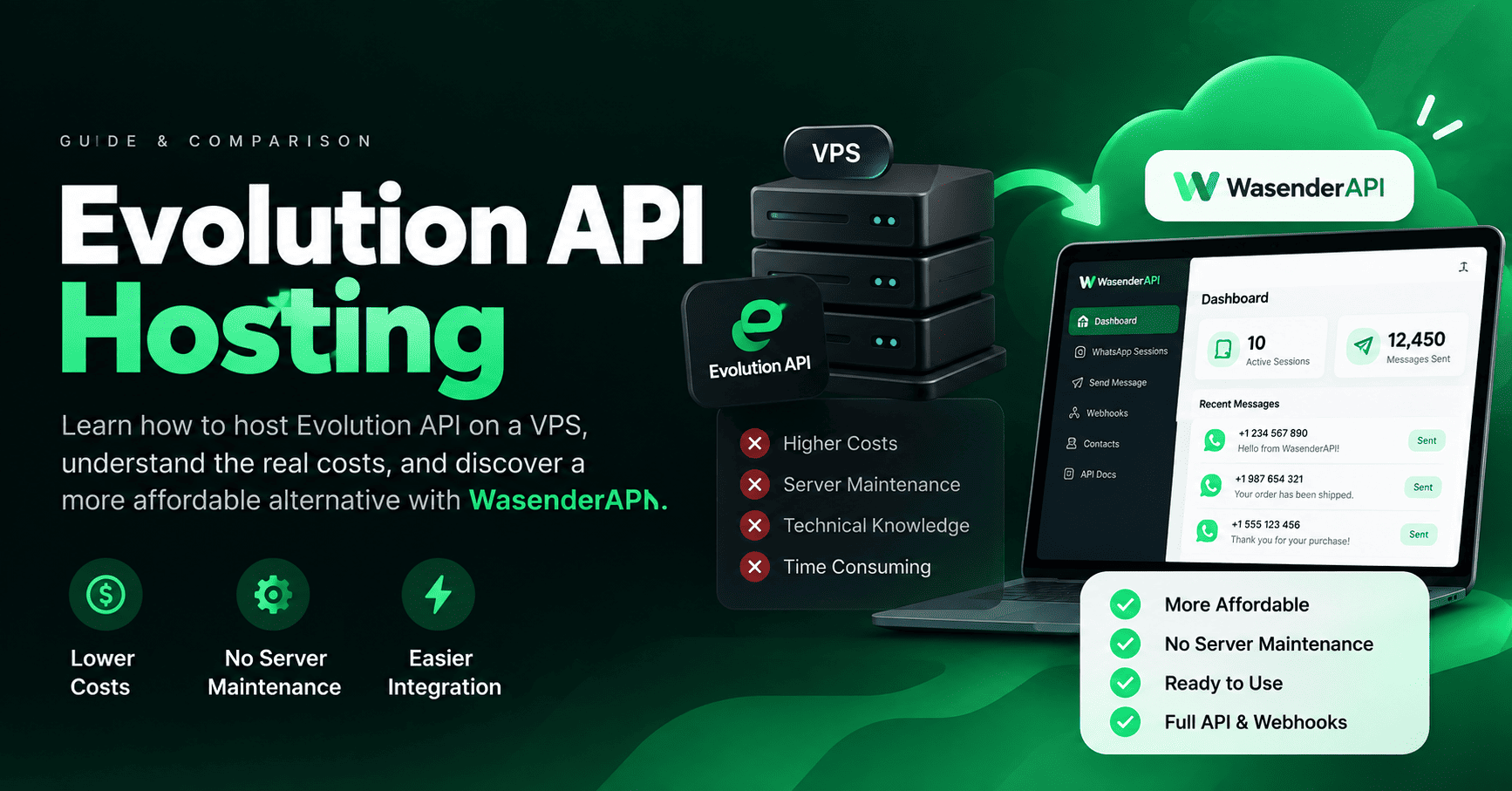
Evolution API itself may be open source, but running it in production still requires infrastructure. You may need to rent a VPS, configure Docker, manage databases, configure HTTPS, monitor your server, maintain backups, troubleshoot issues, and keep the deployment updated.
For smaller projects and developers who do not already have infrastructure, WasenderAPI can be more affordable than renting and maintaining a VPS for a WhatsApp API deployment.
WasenderAPI starts at $6 per month for one connected WhatsApp number, with higher plans available for multiple WhatsApp sessions. This means you can avoid paying for a separate VPS just to run your WhatsApp API infrastructure.
| Self-Hosted Evolution API | WasenderAPI |
|---|---|
| VPS required | Managed infrastructure included |
| Server configuration | No VPS configuration required |
| Docker and dependencies | Managed by the platform |
| Backups and monitoring | Infrastructure managed by the provider |
| Server maintenance | No server maintenance for you |
| Developer time spent on DevOps | Spend your time building your application |
| Monthly infrastructure cost | From $6/month |
Already paying for a VPS? If your server is already running other applications, self-hosting Evolution API may make sense. But if you're renting a VPS primarily for WhatsApp API infrastructure, a managed service can potentially reduce both your infrastructure costs and your maintenance workload.
Evolution API Hosting vs Managed WhatsApp API
Self-hosting and managed APIs solve slightly different problems. The right choice depends on how much infrastructure you want to operate yourself.
| Feature | Self-Hosted Evolution API | Managed WhatsApp API |
|---|---|---|
| Server management | You manage it | Provider manages it |
| Infrastructure | You provide it | Included by provider |
| Updates | You manage updates | Provider handles platform infrastructure |
| Webhooks | Available depending on setup | Usually provided |
| Scaling | You manage resources | Provider manages infrastructure scaling |
| Customization | High | Depends on provider |
| Maintenance | Your responsibility | Reduced operational workload |
When Should You Self-Host Evolution API?
Self-hosting can make sense if you have a technical team and want direct control over your infrastructure.
It may be appropriate when:
- You already operate VPS or cloud infrastructure.
- You are comfortable with Docker and Linux.
- You need extensive control over deployment.
- You have engineers available to maintain the system.
- You want to integrate the service into an existing infrastructure stack.
Remember: Running a WhatsApp integration in production involves more than getting the API online. You should also consider authentication, HTTPS, backups, monitoring, session reliability, resource usage, and the terms and policies applicable to the WhatsApp account and integration method you use.
When Is a Managed WhatsApp API Easier?
If your primary goal is building your application rather than maintaining WhatsApp infrastructure, a managed API can remove a significant amount of operational work.
Instead of spending time configuring servers, developers can connect their application to an API and concentrate on their CRM, SaaS platform, chatbot, automation workflow, or customer-support experience.
WasenderAPI: A Managed Alternative for Developers
WasenderAPI is a developer-focused WhatsApp API designed for applications that need to send and receive WhatsApp messages without building and maintaining the entire infrastructure layer themselves.
The platform provides API access, real-time webhooks, multiple WhatsApp sessions, and support for different message types including text, images, videos, audio, documents, contacts, and locations.
WasenderAPI also uses a subscription-based pricing model rather than charging a fee for every API message. Plans are designed around the number of connected WhatsApp sessions.
Want to skip the server setup? You can connect a WhatsApp account to WasenderAPI, obtain your API credentials, and start integrating with your application without deploying your own Evolution API server.
Evolution API Alternatives
Evolution API is only one option available to developers building WhatsApp integrations. Depending on your requirements, you can consider several approaches.
1. Self-Hosted WhatsApp API
A self-hosted solution gives you maximum infrastructure control but requires more technical maintenance.
2. Managed WhatsApp API
A managed API handles the infrastructure layer for you. This can be useful for SaaS developers who want to minimize DevOps work.
3. Official WhatsApp Business Platform
Businesses can also investigate Meta's official WhatsApp Business Platform and determine whether its capabilities, onboarding requirements, messaging model, and policies fit their use case.
The important distinction is that different WhatsApp integration approaches have different technical architectures, pricing models, capabilities, and policy requirements. Developers should evaluate these factors before choosing an implementation.
Common Evolution API Hosting Problems
Getting an API running is only the first step. Production deployments can encounter operational issues that are easy to overlook during development.
Server Resource Usage
Running multiple sessions and supporting services increases resource requirements. Monitor CPU, RAM, disk usage, and network traffic as your deployment grows.
Session Management
WhatsApp sessions need to remain available and correctly managed. Unexpected disconnections can affect applications that depend on continuous messaging availability.
Backups
A production deployment should have a backup strategy for important configuration and application data. Backups are especially important when the API is part of a business-critical workflow.
Monitoring
Uptime monitoring, application logs, resource monitoring, and alerting can help identify problems before they become larger outages.
Updates
Self-hosted software requires ongoing maintenance. Before upgrading, test changes in a staging environment where possible and maintain a rollback strategy.
How to Choose the Right WhatsApp API
Before choosing an API, consider more than the monthly price.
- Deployment: Do you want to manage your own servers?
- Scalability: How many WhatsApp sessions do you need?
- API: Does it provide the endpoints your application requires?
- Webhooks: Can your application receive real-time events?
- Message types: Are text, media, documents, contacts and locations supported?
- Pricing: Is pricing based on sessions, messages, users, or another metric?
- Maintenance: Who handles infrastructure and operational issues?
- Compliance: Does the integration approach fit your intended use and applicable platform policies?
Frequently Asked Questions
What is Evolution API hosting?
Evolution API hosting means running the Evolution API software on infrastructure you control, such as a VPS or cloud server, and configuring the required supporting services.
Can I host Evolution API on a VPS?
Yes. A VPS is a common type of infrastructure for self-hosting API applications. Your exact server requirements depend on the version, configuration, number of sessions, and workload.
Is Evolution API free?
Evolution API is an open-source project, but running it in production still involves infrastructure and operational costs such as server hosting, storage, backups, monitoring, and maintenance.
Is WasenderAPI cheaper than a VPS?
It can be, particularly for developers who would otherwise rent a VPS specifically to run their WhatsApp API. WasenderAPI starts at $6 per month for one connected WhatsApp number, while self-hosting also requires you to account for server costs, maintenance, backups, monitoring, and your own time.
What is the easiest alternative to hosting Evolution API?
A managed WhatsApp API can eliminate much of the server-management work. WasenderAPI is one option for developers who want API access, webhooks, multiple WhatsApp sessions, and subscription-based pricing without managing their own API infrastructure.
Does WasenderAPI require me to host a VPS?
No. WasenderAPI is a hosted service, so you don't need to deploy and maintain your own Evolution API server to use its API.
Final Thoughts
Evolution API hosting can be an attractive option for developers who want control over their WhatsApp API infrastructure and are comfortable managing a self-hosted deployment.
However, hosting an API in production involves more than installing the software. Server resources, security, backups, monitoring, updates, session management, and operational maintenance all become part of your responsibility.
For developers who would rather avoid VPS costs and infrastructure management, WasenderAPI offers a managed alternative starting at $6/month for one connected WhatsApp number.
Instead of spending time configuring and maintaining a server, you can connect your WhatsApp account and focus on building your application, CRM, chatbot, SaaS platform, or automation workflow.